
Your Walls Are Talking to Your Brain: Are You Listening?
Here's something most people don't realize:
Your empty walls are literally starving your brain.
I know that sounds dramatic, but stay with me.
Because the science behind this is absolutely mind-blowing.
What Your Brain NEEDS (But Isn't Getting)
We spend 90% of our lives indoors.
Think about that for a second.
90%.
And most of those indoor spaces? They're visually BARREN.
White walls. Sterile environments. Zero connection to nature.
But here's the thing: your brain evolved over millions of years in nature. It's WIRED to seek out natural patterns, colors, and forms. When you deprive it of these elements, you're essentially putting it on a starvation diet.
Finding #1: Nature Elements Trigger Neuroplasticity
A groundbreaking 2025 study published in HERD: Health Environments Research & Design Journal found something incredible: biophilic design, that's integrating natural elements into built spaces, actually promotes neurogenesis in the hippocampus. What does that mean in plain English?
Your brain literally GROWS new neurons when exposed to nature-inspired art and design.
The hippocampus is the part of your brain responsible for memory and emotional regulation. When you surround yourself with biophilic elements, you're giving your brain the tools it needs to:
Process emotions more effectively
Build new neural pathways
Strengthen memory formation
Support healing and recovery
Finding #2: Enriched Visual Environments Reshape Your Brain's Structure
A comprehensive 2014 review in Physiological Reviews examined decades of research on environmental enrichment. The findings?
STUNNING.
When your environment includes visual complexity, like nature-inspired art, your brain undergoes dramatic changes:
Increased cortical thickness
Enhanced synaptic connections
Elevated production of BDNF (brain-derived neurotrophic factor)
Improved cognitive flexibility
Better stress response
The researchers found that visual stimulation from enriched environments triggers the same biological processes that accelerate brain development and maintain neuroplasticity throughout your entire life.
Translation: You can literally shape your brain by what you put on your walls.
Finding #3: Natural Imagery Creates Measurable Brain Responses
Research from the Academy of Neuroscience for Architecture found that images of nature consistently trigger strong, positive neurological responses in the brain's reward centers.
When people view nature-based art, brain scans show:
Increased blood flow to regions associated with pleasure (up to 10%)
Activation of the brain's reward system
Release of dopamine, serotonin, and oxytocin
Reduced activity in stress-related brain areas
Here's what blew my mind: viewing sublime nature art produces the SAME brain response as looking at a loved one.
The same.
The Cost of Empty Walls
Now let's flip this around. What happens when your walls are EMPTY?
Research on visual deprivation shows something sobering: when the brain is deprived of visual stimulation, it undergoes negative changes.
Studies demonstrate that:
Lack of visual enrichment can slow cognitive development
Barren environments suppress the brain's natural plasticity
Visual deprivation alters cortical structure
Empty spaces fail to activate crucial neural networks
Think about it this way: If you wouldn't feed your body empty calories, why would you feed your brain empty walls?
Your Environment Is Your Medicine! Here's what I want you to understand:
Healing is possible when experiencing art.
The research proves it. Your walls aren't just decoration, they're a delivery system for neuroplasticity, emotional regulation, and cognitive health. When you fill your space with biophilic design, semi-abstract landscapes rooted in nature's patterns, colors that soothe and energize, forms that echo the natural world, you're not just making things "pretty."
You're literally:
Activating neurogenesis in your hippocampus
Strengthening neural pathways that support emotional wellbeing
Reducing stress-related brain activity
Enhancing cognitive performance
Supporting your brain's natural healing processes
The Employee Wellbeing Connection
For HR executives and workplace designers: this isn't just about aesthetics. This is about PERFORMANCE. About RETENTION. About creating spaces where people can actually THRIVE. When employees spend 8+ hours a day in environments without biophilic elements, you're asking their brains to function at a deficit.
The research shows that enriched visual environments lead to:
Better focus and concentration
Enhanced creativity and problem-solving
Reduced sick days
Lower stress and anxiety levels
Improved overall job satisfaction
Can you afford NOT to prioritize biophilic design?
The Healthcare Connection
For healthcare facility managers and interior designers working in medical spaces: Your design choices directly impact patient outcomes.
Studies in hospital settings show that biophilic design elements:
Reduce patient anxiety and depression
Lower pain perception
Speed recovery times
Improve patient satisfaction scores
Support emotional regulation during difficult experiences
Art heals.
The science backs it up.
What You Can Do RIGHT NOW
Don't let another day go by with your walls sending the wrong message to your brain.
Start small:
Assess your space – Where are the blank walls?
Choose nature-inspired art – Look for pieces with organic forms, biophilic colors, peaceful landscapes
Think beyond decoration – Consider this an investment in brain health
Create variety – Different spaces can support different cognitive and emotional states
The Bottom Line
Your brain is INCREDIBLE. It can change. It can heal. It can grow new neurons. But it needs the right environment to do its best work. Empty walls aren't neutral, they're a missed opportunity for healing, growth, and transformation. You can shape your brain. You have that power. And it starts with what you choose to put on your walls.
Art heals. Science proves it. Your brain deserves better.
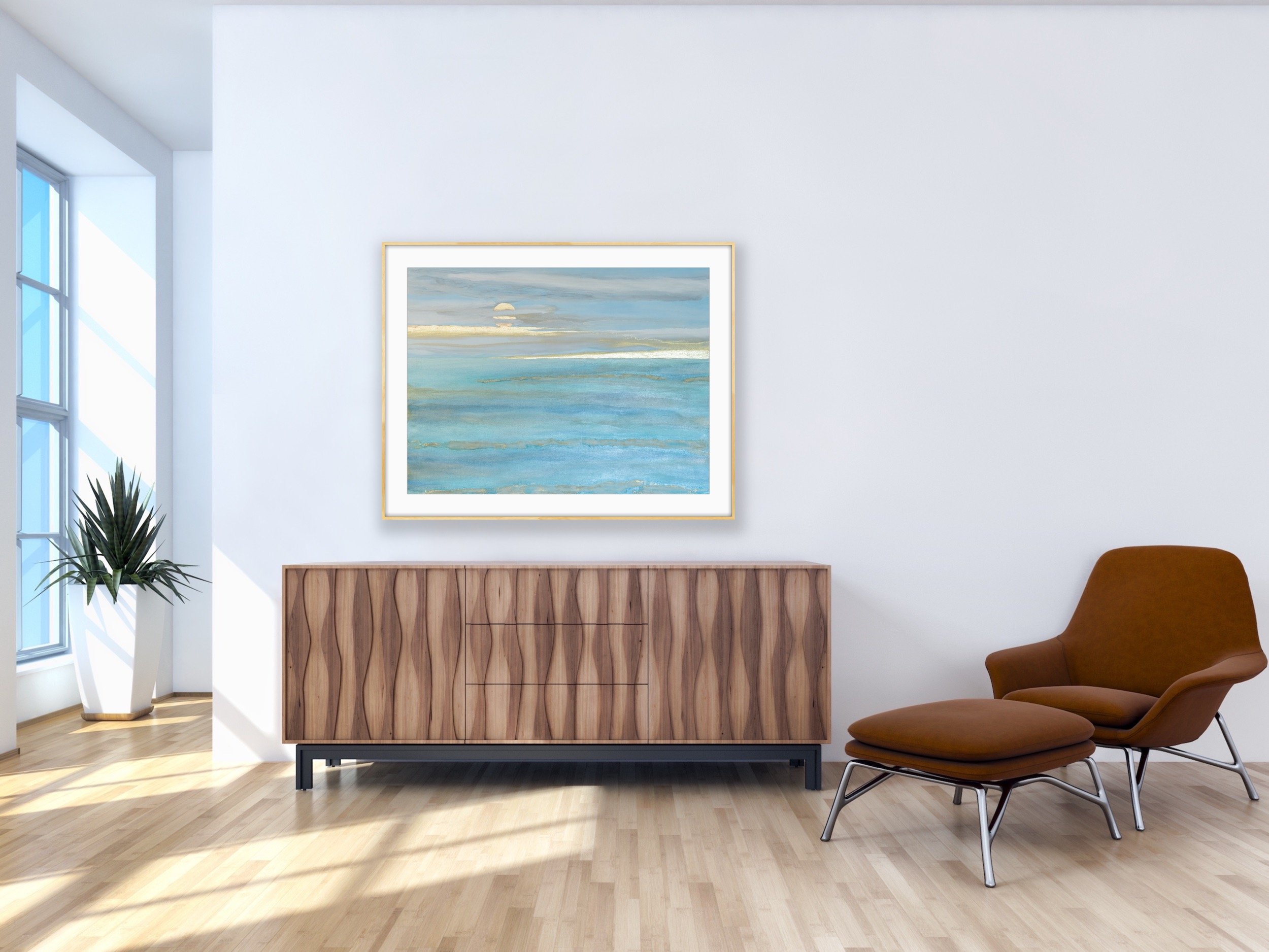
Ocean Bliss III by Claudia Vergara
Claudia Vergara is an artist specializing in semi-abstract landscape paintings rooted in biophilic design principles and color psychology. With a PhD in identity development and over 15 years of art research experience, she combines scientific research with artistic practice to create work that supports healing and neuroplasticity. Her paintings are available as originals, prints, and can be developed into custom wallpaper for commercial and residential spaces.
References
Scorza, F.A., Attis, C., Wuo-Silva, R., Ciconelli, R.M., & Chaddad-Neto, F. (2025). Biophilic Design: Healthy Buildings, Healthy Brain. HERD: Health Environments Research & Design Journal. DOI: 10.1177/19375867251330819
Sale, A., Berardi, N., & Maffei, L. (2014). Environment and Brain Plasticity: Towards an Endogenous Pharmacotherapy. Physiological Reviews, 94(1), 189-234. DOI: 10.1152/physrev.00036.2012
Browning, W., Ryan, C., & Clancy, J. (2014). 14 Patterns of Biophilic Design: Improving Health & Well-Being in the Built Environment. New York: Terrapin Bright Green. Academy of Neuroscience for Architecture research studies. Available at: https://anfarch.org
